
Tax Lessons in Everyday Financial Decisions
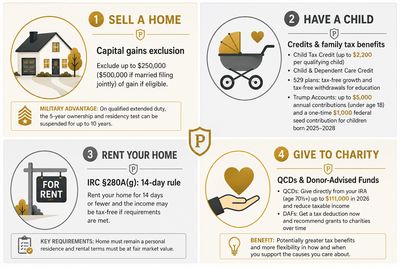
"Many of our conversations with client families revolve around life's biggest financial decisions, including selling a home, welcoming a child, renting out a property, or making a charitable gift. While these moments are rarely driven by taxes, they often create planning opportunities that can have a meaningful impact on your long-term financial picture. Understanding those tax implications can help you keep more of what you've earned while ensuring your financial plan continues working as intended.
SELLING A HOME IS NOT ALWAYS TAXABLE
Homeowners can exclude up to $250,000 of capital gains from the sale of a primary residence ($500,000 for married couples filing jointly), provided they've owned and lived in the home for at least two of the past five years. For example, if you purchased your home for $250,000, lived there for 10 years, and sold it for $500,000, the entire gain may be tax-free!
Active-duty servicemembers receive an additional benefit. While on qualified extended duty, the IRS generally allows the normal five-year ownership and residency testing period to be suspended for up to 10 years, making it much easier to preserve the home sale exclusion despite PCS moves or long-term deployments.
However, not every home sale qualifies automatically. Prior rental use, business use, or moving before satisfying the residency requirements can reduce or eliminate part of the exclusion. If you are already considering a move, reviewing the tax implications beforehand may preserve benefits that cannot be recovered later.
HAVING A CHILD IS MORE THAN JUST A NEW FAMILY MEMBER
Welcoming achild can also create valuable tax planning opportunities. The Child Tax Credit can reduce your federal tax bill by up to $2,200 per qualifying child, and families paying for childcare while working may also qualify for the Child and Dependent Care Credit.
It's also an excellent time to begin saving for your child's future. A 529 education savings plan allows investments to grow tax-free, and qualified withdrawals for education expenses are also tax-free. Many states also offer additional tax incentives for contributions.
Families now have another savings option as well. Trump Accounts, which recently became available, allow eligible children under age 18 to receive up to $5,000 annually into a tax-advantaged investment account. Children born between 2025 and 2028 may also qualify for a one-time $1,000 federal seed contribution.
Although taxes are rarely top of mind when welcoming a new child, making a few planning decisions early can create tax savings today while building financial flexibility for the years ahead.
RENTING OUT YOUR HOME: A LITTLE-KNOWN TAX RULE
Many homeowners may rent their property for a short period during a major local event (i.e., on the Monterey Peninsula that includes golf tournaments, Pebble Beach Concours d'Elegance car show or Pebble Beach Food & Wine, etc.). Few realize the tax code contains a special provision that may make this income completely tax-free.
Under Internal Revenue Code Section 280A(g), sometimes called the ""Masters Rule,"" homeowners who rent their personal residence for 14 days or fewer during the year generally do not have to report that rental income on their federal tax return, provided the home remains a personal residence under IRS rules. The nickname comes from Augusta, Georgia, where many homeowners rent their homes during Masters Tournament week.
This strategy can produce meaningful tax savings, but documentation is essential. Rental rates should reflect fair market value, and the rule applies only if specific requirements are met.
CHARITABLE GIVING: GIVING SMARTER, NOT JUST MORE
For retirees age 70½ or older, Qualified Charitable Distributions (QCDs) allow gifts of up to $111,000 in 2026 to be made directly from an IRA to qualified charities. These gifts can satisfy required distribution rules, when applicable, while keeping the donated amount out of taxable income. For many households, this provides a greater tax benefit than claiming a charitable deduction.
Another effective strategy is a Donor-Advised Fund (DAF). A DAF allows you to make a large charitable contribution in one year and receive an immediate tax deduction while recommending grants to charities over many future years. This approach is often especially valuable after selling a business, realizing large investment gains, or experiencing another unusually high-income year.
GOOD FINANCIAL DECISIONS DESERVE GOOD TAX PLANNING
A comprehensive financial plan does more than just consider investment accounts. It helps coordinate tax strategy with the decisions you are already making so that your financial life works together. If you're navigating a major financial decision, we'd be happy to help you evaluate how it fits into your broader financial plan."