
Retirement Spending: The "Bumper" Framework
When most people think about retirement, a few questions often come to mind: "How much can I spend?" "What portfolio amount do I need to feel comfortable?" "Do I have enough?" These are all reasonable questions, but they all assume something that may not be true: that retirement can be solved with a single number. We at Praetorian Guard instead like to think about it as a range of sustainable spending over time and having a system in place to stay within that range.
Retirement Spending Changes Over Time
It's common to assume that spending remains steady throughout retirement, such as a consistent $10,000/month. In reality, many retirees tend to follow a more natural pattern:
- Early retirement: Spending is often at its highest. This is when people travel, pursue hobbies, and take advantage of their time as "active retirees".
- Mid-retirement: Spending begins to gradually decline as priorities shift and activity levels change.
- Later years: Overall spending is typically lower, even as certain costs like healthcare may increase.
If we force a flat spending assumption onto a variable reality, it can lead to overestimating what's required. This could then lead to an artificially high probability that spending adjustments are needed, which pre-retirees could interpret as needing to work longer when they may not.
It also does not account for timing of risk, sometimes referred to as sequence of return risk. Market declines early in retirement, combined with ongoing withdrawals, can have a lasting impact on a portfolio if not properly addressed. A fixed spending plan typically does not adapt well to that risk.
Why Spending "Bumpers" Create Better Plans
This is where a different framework can be helpful. Instead of solving for a single number, consider a spending range. A helpful analogy for this is to imagine yourself bowling. Without the bumpers up, every throw has to be precise or there's a good chance the ball ends up in the gutters. With the bumpers, you still aim for the center pins, but you have guardrails to keep you on track.
When we apply this analogy to retirement planning, the guardrails look like this:
- A lower bumper ("green" zone): This is where under-spending occurs and, if sustained, may leave a larger legacy portfolio than intended.
- A target spending level: This is the lane. This serves as the baseline target that provides a good balance between ensuring your portfolio outlasts you but also lets you achieve your goals and pursue your desires.
- An upper bumper ("red" zone): This is where spending becomes too aggressive and, if sustained, may lead to you outliving your portfolio.
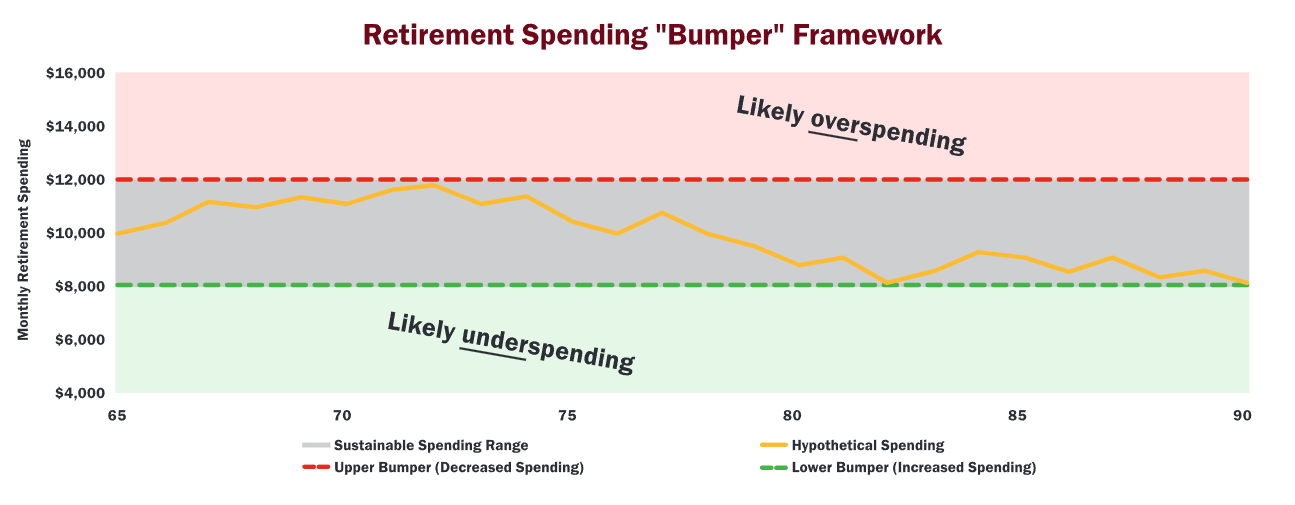
This is a hypothetical example that illustrates a common retirement experience of increased spending early on in retirement followed by a gradual decrease during the later years.
This approach replaces "budget paranoia" and the pressure of perfection with something more realistic: the flexibility to spend more when conditions are favorable and make modest pullback adjustments when they're not. This gives people confidence and control that they have a plan to keep them on track when life inevitably changes.
The Retirement "Vision" Conversation
The effectiveness of the "bumper" approach depends on when the planning begins. In our experience, the most meaningful retirement plans are built at least 3-5 years before retirement. We sometimes refer to this as the "vision" conversation, which shifts from asking the questions at the beginning of this article to things like:
- What are my expectations and concerns about retirement?
- Who do I want to spend retirement with?
- What will give my days structure and purpose?
This qualitative approach makes it much easier to determine a starting point for spending and how much flexibility the plan can support. Retirement planning is about meaning and purpose in life just as much as it is about numbers. Having the "vision" conversation makes the path forward far more personal, and therefore more attainable.
Set The Bumpers Before You Start Rolling
A successful retirement plan isn't about hitting a perfect number every year. It's about staying within a range that supports your lifestyle over time. Many things will change: spending will ebb and flow, markets will inevitably fluctuate and priorities will evolve. The goal is not to predict every outcome, but to instead build a framework that can adapt.
The "vision" conversation is your opportunity to define what you want the next phase to look like, establish your spending "bumpers" to support that vision, and identify any adjustments needed before you begin. If you're approaching retirement (or already there) and need help aligning your resources and long-term goals with a spending range, it may be worth revisiting how your current plan is structured.