
Practical Social Security Information
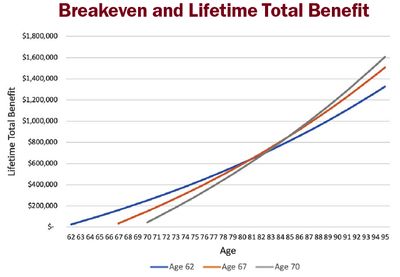
For many Americans approaching retirement, the decision about when to take Social Security is one of the most consequential financial decisions they will make. Social Security represents a lifetime, inflationadjusted stream of income that is often the foundation of a retirement plan. Yet as important as the decision is, there is no single “right” age to claim Social Security. The decision depends on a multitude of factors, including health, life expectancy, employment plans, other sources of income, spending goals, and, for married couples, how when one spouse claims can affect the other spouse.
When Can You Claim Social Security?
For anyone born in 1960 or later, Social Security considers age 67 to be their Full Retirement Age (FRA). At age 67, retirees are entitled to 100% of their calculated benefit, often referred to as their Primary Insurance Amount (PIA). Claiming before or after FRA adjusts the benefit from this amount.
The earliest a person can claim Social Security benefits is at age 62. However, claiming before FRA has two potential drawbacks. First, it permanently reduces the monthly benefit. Although the reduced benefit will receive annual Cost-of-Living Adjustments (COLA), the reduction for claiming early is permanent. The reduction for claiming at age 62, for someone whose FRA is age 67, is 30%. The reduction schedule is detailed in the chart below:
Age | FRA Benefit | Reduction From FRA | Reduced Benefit Amount
67 (FRA) | $3,000 | — | —
66 (Age 50+) | — | 6.67% | $2,799 per month
65 | — | 13.33% | $2,599
64 | — | 20% | $2,399
63 | — | 25% | $2,250
62 | — | 30% | $2,100
One important point is that the reduction is calculated monthly, not simply by year. For example, someone claiming two months before FRA would only have a reduction of about 1.1%.
The second potential drawback for taking Social Security early occurs if a person continues to work before reaching FRA and earns above a certain threshold. For 2026, someone who will remain below FRA for the entire year can earn up to $24,480. Workers who earn more than this amount will have $1 withheld from their Social Security benefit for every $2 earned above $24,480.
For those reaching FRA this year, the earnings cap is $65,160. They will have $1 withheld from their benefits for every $3 earned above $65,160 before the month in which they reach FRA. Those drawing Social Security who have already reached FRA retain 100% of their benefits regardless of how much they earn from working.
For those who wait until after reaching FRA to begin drawing their benefits, there is a reward in the form of an increased benefit. For each year that a retiree waits to claim Social Security, their benefits are increased by 8%. An example is shown in the chart below.
Age Benefits Begin | Percent of FRA Benefit | Example Benefit Amount
67 | 100% | $3,000 per month
68 | 108% | $3,240
69 | 116% | $3,480
70 | 124% | $3,720
Taxation of Social Security Benefits
Social Security benefits may be subject to income tax depending on a retiree’s combined income. This combined income is different than the Modified Adjusted Gross Income (MAGI) used elsewhere in the tax code. For an individual filer, combined income above $25,000 may cause up to 50% of Social Security benefits to become taxable, while combined income above $34,000 may cause up to 85% of benefits to become taxable. For married couples filing jointly, the corresponding thresholds are $32,000 and $44,000. Importantly, this does not mean that benefits are taxed at an 85% tax rate. Rather, up to 85% of the benefits received may be included as taxable income then taxed at the applicable marginal tax rate.
The calculation is unusual. Social Security’s “combined income” generally equals adjusted gross income, plus tax-exempt interest (usually from Municipal Bonds), plus one-half of Social Security benefits. As a result, municipal bond interest, although generally exempt from federal income tax, can still affect how much of a retiree’s Social Security benefit becomes taxable.
Why Would Someone Claim Early?
Given the reduction in benefits, it may seem logical that everyone should simply wait until 70. Retirement planning, however, involves more than maximizing a monthly check.
Consider someone who retires at age 62 with some savings and dreams of spending the next several years traveling. They are healthy today and want to hike through Europe, take extended vacations, or spend more time visiting children and grandchildren. An additional source of income in their early 60s may help them enjoy those experiences while they are physically able to do so.
Health and longevity are also important factors. Someone with a serious medical condition or a family history suggesting a shorter life expectancy may reasonably decide that receiving smaller payments sooner is preferable to waiting years for a larger benefit that they might not receive for very long.
Others simply need the income. Claiming early could reduce the amount they must withdraw from investment accounts during the first several years of retirement. For some retirees, there is value in having a predictable monthly income stream rather than relying on portfolio withdrawals.
Why Wait Until 70?
For retirees who have sufficient assets to fund their early retirement years, delaying Social Security can be a valuable planning strategy.
First, delaying provides a substantially larger guaranteed monthly benefit. A person entitled to $3,000 at age 67 would receive approximately $36,000 annually at FRA versus about $44,640 annually at 70. That higher starting benefit can be particularly valuable for someone who lives well into their 80s or 90s.
Social Security also provides annual cost-of-living adjustments. Because those adjustments apply to your benefit amount, delaying creates a larger base upon which future adjustments are calculated.
Longevity is perhaps the strongest argument for waiting. Retirees often focus on the possibility of dying young, but the opposite risk can be financially more challenging: what happens if you live much longer than expected? Someone retiring today could potentially need income for another 30 or even 40 years. A larger Social Security benefit provides additional protection against that longevity risk.
For married couples where one spouse had significantly higher earnings during their career, the decision is especially important. In many situations, delaying the higher earner’s benefit can provide greater financial protection for a surviving spouse. When one spouse dies, the surviving spouse may be eligible to receive a survivor benefit based on the deceased spouse’s benefit, making the higher earning spouse’s claiming decision a decision that can affect both spouses.
Conclusion
There is no “right” age to claim Social Security. The right decision is the one that best fits your health, financial resources, goals, and family circumstances. Individuals can check their estimated Social Security benefits directly on the Social Security website at ssa.gov.
As you approach this important decision, your advisor at Praetorian Guard can help you evaluate the trade-offs, model different strategies, and help determine how Social Security fits into your broader retirement plan.